How to Plan a CliftonStrengths Workshop for Your Team: Answers to the Questions Leaders Ask
If you're thinking about bringing Gallup® CliftonStrengths® to your team (you might know it by its former name, StrengthsFinder®), you probably have questions. Who should take part? How long should the workshop be? What should happen before it, and after it? And how will you know it's working? This article answers the questions leaders ask me most, roughly in the order you'll face them.
As a Gallup-Certified Strengths Coach, I design and lead CliftonStrengths workshops for teams. My answers here are general, drawn from what I've seen working with teams. Where something is specific to how I work, I'll say so.
When someone reaches out to me about a workshop, it isn't always the leader. Often, it's someone who's been asked to organize it.
In my experience, the people who reach out arrive from one of two places. Some have heard about CliftonStrengths, somewhat buy into the idea, and hope it'll help. Others went through it on their own, felt it helped them, and want to bring it to their group so it can do the same. Either way, many haven't yet pictured what it could do for their group. So the request usually starts with the logistics.
I often get requests for a short workshop to fit into a multi-day meeting. It's when everyone will be together, so why not add this to the in-person time too? Right away, I can sense that the workshop is being seen as one more thing to fit between higher-priority topics. It isn't being looked at for what it will add to the group. It's being planned and presented through its constraints.
I get it. Time and budget are real, and constraints are something I ask about. I don't want to ignore them. They just shouldn't be the focus when you're exploring how CliftonStrengths could transform your team. The more I understand about an organization (what it's hoping for, its goals, and its current challenges), the more I can think about how to give the team as much value as possible while respecting its limits. I don't want to come in with a cookie-cutter answer: "This is what I can do in the time you're allotting." Instead, I want to understand all the variables upfront, then propose an approach that meets the team's goals while considering its limitations.
That's why there's one question I'd encourage you to answer before any of the others, and it's the one that usually gets skipped: what do you want this work to add to your team? Put another way, who do you want your team to become? That picture, and the reasons behind it, is what I call your Vision.
Start with what you want this work to add to your team. Then plan the workshop around it.
For me, this is personal. I didn't understand the value of CliftonStrengths until I had the chance to dive deeper, beyond the introductory topics. And that's what I want for the teams I work with: to get the depth out of the tool, and to understand the power in it.
So before you read on, take a moment with your own team in mind. What do you hope this work will add? What's getting in the way right now? And who do you want your team to become? Your answers will shape every other decision in this article.
Maybe you're planning just one workshop, because that's what you came here for. It's a strong start, and it may be what's realistic for your team right now. But you can build more around it, and in this article I'll show you what that can look like. If you'd like the full picture of what makes the work last (what I call a rollout), I walk through it in my article on the topic: CliftonStrengths for Teams: What It Takes to Make a Rollout Stick.
The questions this article answers
- What could a CliftonStrengths workshop change for our team?
- Is one workshop enough?
- Who should take part in a CliftonStrengths workshop?
- How long should the workshop be, and should it be in person or online?
- What should happen before the workshop?
- What should happen during and after the workshop?
- When will we see a difference, and how will we know it's working?
Shorter questions (Top 5, Top 10 or all 34, existing results, cost, timing, new team members, and choosing a coach) are in the frequently asked questions at the end.
What could a CliftonStrengths workshop change for our team?
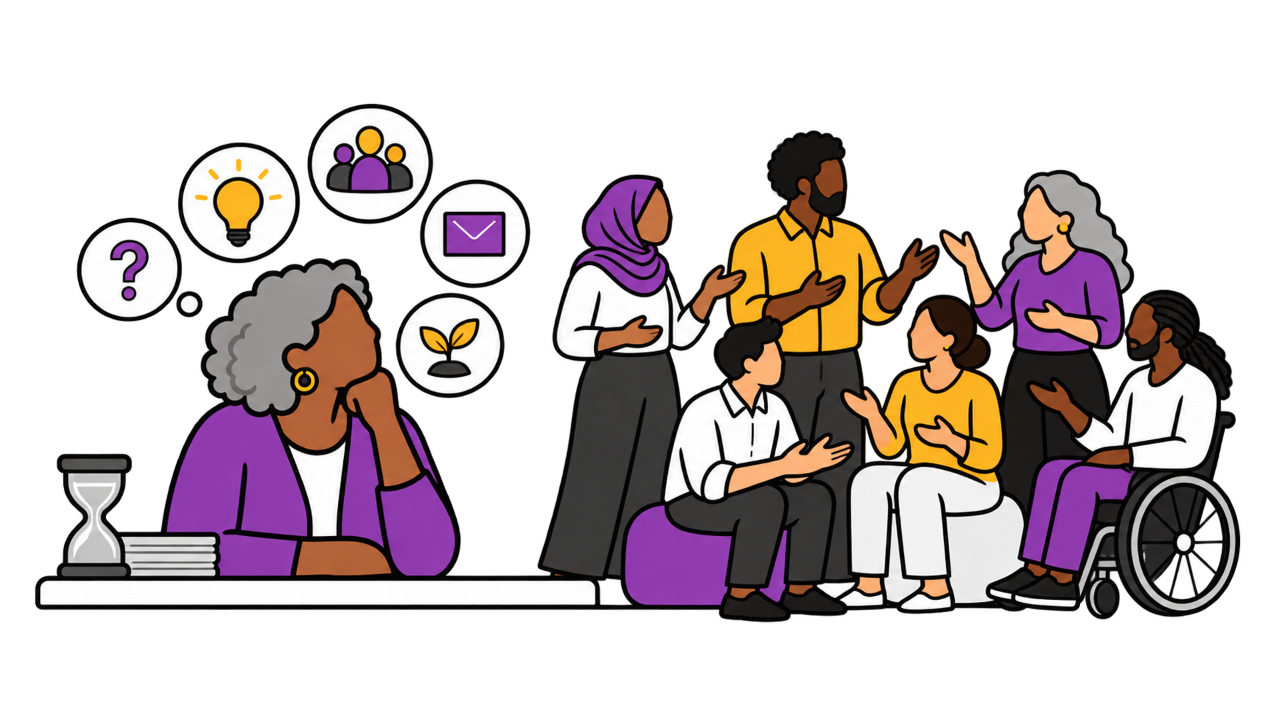
The most impactful change I see is that friction is removed, or at least reduced. No matter how good a team is, there's going to be friction somewhere. Imagine what your people could accomplish if the energy they spend working through internal conflicts went into serving your organization and its goals instead.
To see why, it helps to know what CliftonStrengths shows you. If it's new to you, it's an assessment from Gallup that helps you discover your natural patterns of thinking, feeling, and behaving that can be productively applied. Your results identify your predominant Talent Themes, out of 34. Here are two definitions that will help as you read:
CliftonStrengths Vocabulary
Talent: a naturally recurring pattern of thought, feeling, or behavior that can be productively applied
Talent Theme: a category of Talents (a grouping of similar Talents)
You'll also see me mention Strengths (what your Talents can become when you invest in them) and Strengths-based Thinking (building on what people naturally do well, instead of focusing only on fixing problems).
When people take the time to understand each other's Talent Themes, they discover that their challenges usually aren't personal, and that no one is being difficult on purpose. They're simply looking at the exact same situation through different lenses, so they prioritize different approaches.
I've seen this happen in workshop after workshop. Here's one example. In a one-time workshop with a media and design company, I put two men together for a pairing activity, without knowing their history. They had a difficult working relationship, and on their own during the activity, they went back to a major conflict they'd had over a customer they hadn't been able to help. One managed that customer relationship directly and was focused on helping the customer. The other worked on the product and development side, a step removed from it. As they understood each other's Talents better, each could see where the other had been coming from. It opened up a block in their working relationship, and it gave them some language, and a place to be curious about each other's point of view, for future situations.
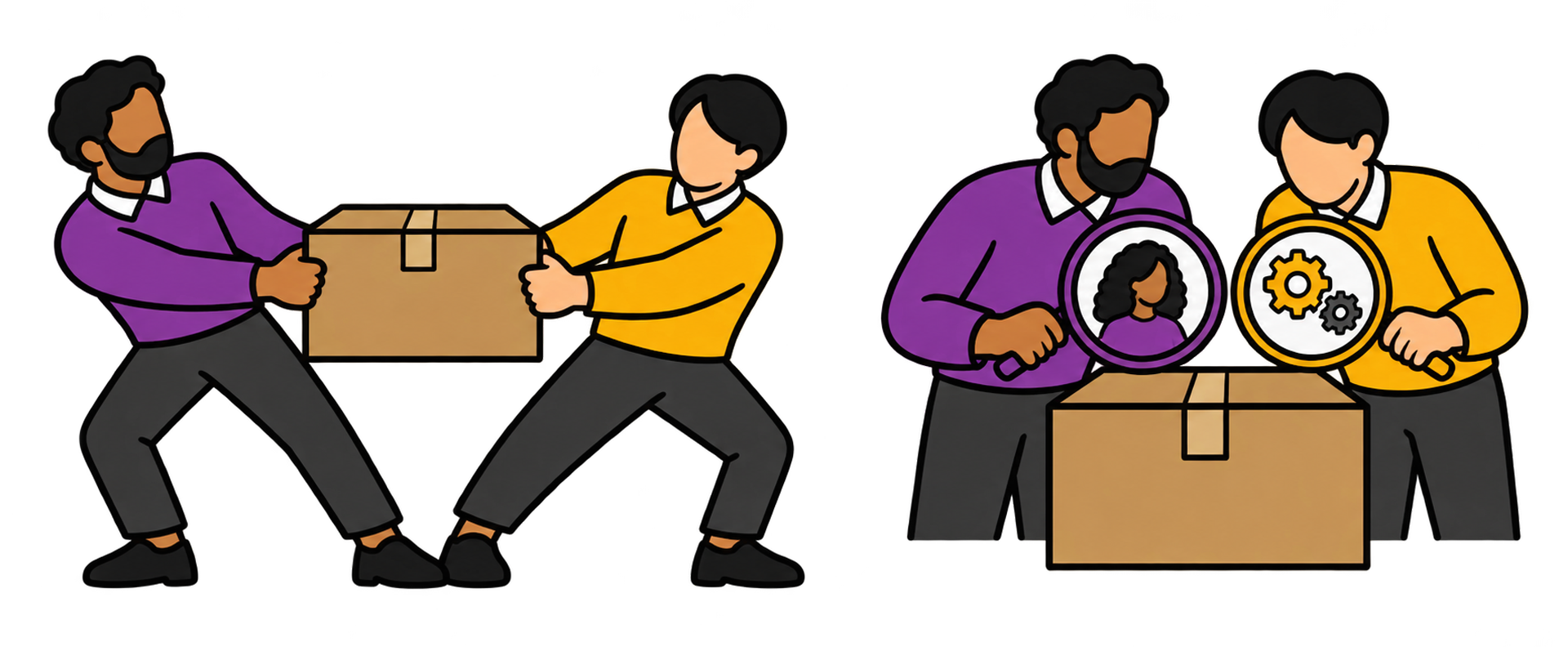
What ends up happening is that people learn they can intentionally seek out someone with different Talent Themes, to see a challenge from an outside perspective. Together, they may come up with several new ideas for how to move forward.
I don't expect everyone to be as interested in this work as I am. But I do want leaders to see what their group already has. Every team has natural Talents, and likely some that are untapped: Talents people have but aren't using yet. When a team learns to develop them, it has more to draw on as it moves forward.
Think about your own team. Where does friction show up most often? Who tends to see things very differently from whom? And what might change if they understood why and learned to work with those differences?
Most friction isn't personal. It's people looking at the same situation through different lenses.
Is one workshop enough?
For many teams, one workshop is what's realistic, at least for now. Time and budget can make it hard to imagine investing in more. And a workshop can be a strong start. But on its own, it won't change how your team works. What makes the work last is the repetition that follows.
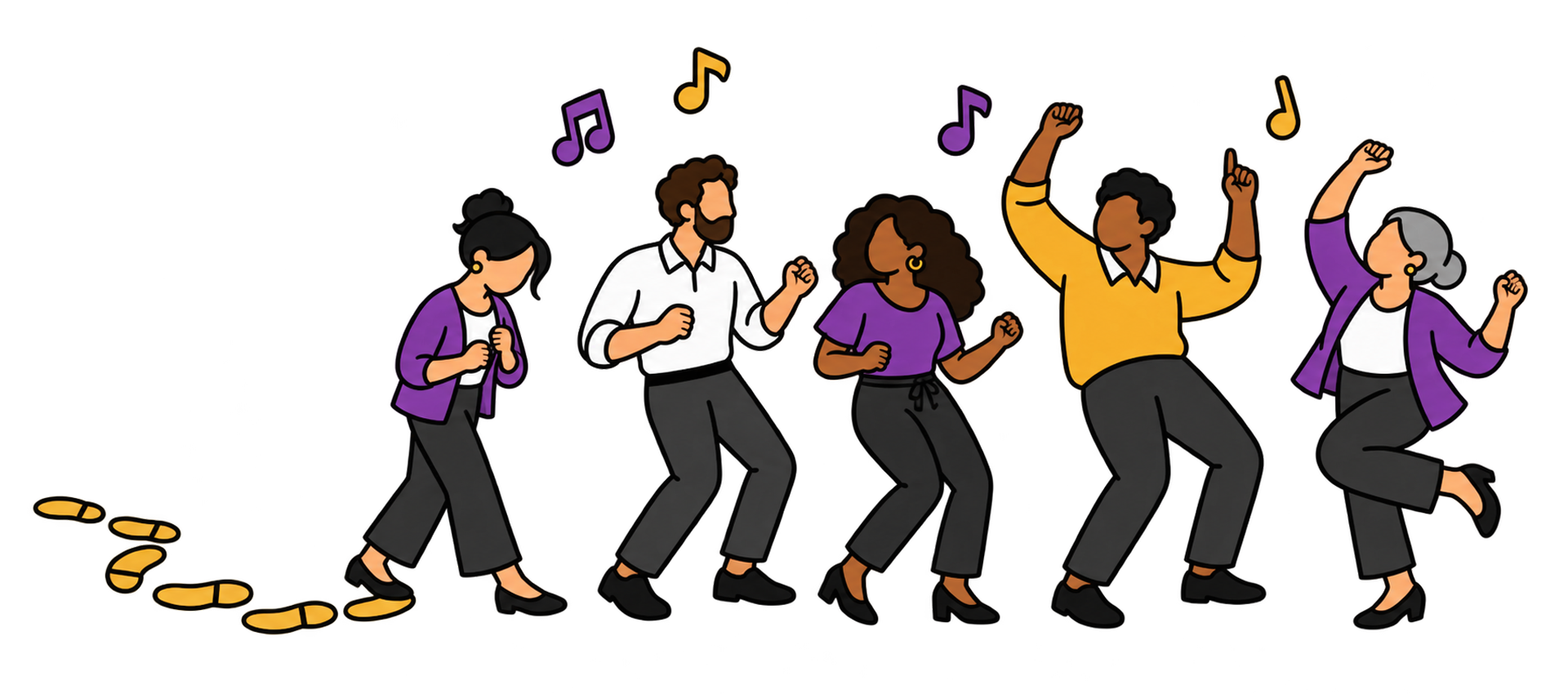
It's a lot like learning to dance. One class isn't enough. In class, you learn steps and moves, the way a workshop teaches you concepts. You might even learn a routine, and that's a real start. But it takes practice before you can dance naturally to the music on your own, without the choreographed steps. When you get good, your body holds muscle memory. It can respond in numerous ways in the moment, to any music - not just to the few scenarios you learned.
Without that practice, you react instead. You rely on one default move every time the same situation comes up. That's not dancing. It's reacting. The same is true of your Talents: autopilot is reacting with a default move, instead of intentionally choosing how to respond with the Talents you have available to you.
This gap between knowing and doing isn't unique to dancing, or to CliftonStrengths. It shows up whenever people learn something new and try to make it part of how they work. In their book The Knowing-Doing Gap, Stanford professors Jeffrey Pfeffer and Robert Sutton argue that the gap between knowing what to do and doing it is larger than the gap between knowledge and ignorance. Knowing isn't the hard part. Doing it, again and again, is.
Gallup has seen something similar in organizations. According to Gallup's own research, companies see roughly a 7% rise in engagement just from having people take the assessment. Organizations that go further and build Strengths across the company see roughly a 23% rise. The tool is the same. The difference is everything you build around it.
So is a workshop enough? It depends on the team. Is there repetition? Is there space for what people learned to be used beyond the workshop? Will managers bring it into everyday language, and will some peers model it too? You'll find practical ways to do that below, under What should happen during and after the workshop?
And if your team can do more than a workshop, don't stop there. Here's what you can build around it:
- Follow-up sessions: an hour or two every month or two, to build on the basics, add new concepts, or make room for group discussion.
- One-to-one coaching: for everyone or a selected group, so each person can work out how this applies to their own role.
- Manager and leader development: because they're the ones who carry this into their teams, day to day.
- In-house support: someone certified in-house, or an ongoing relationship with a coach, so the work keeps going after the workshop.
Each one adds more of the repetition that makes the work last. And whatever you choose, think of the workshop as the first step of something bigger: who you want your team to become.
A workshop starts the change. The repetition afterward is what makes it last.
Who should take part in a CliftonStrengths workshop?
Everyone on the team, including the leader. And the leader should be in the room as a participant, alongside their team members, not watching from the side or going through it separately.
This work isn't about hierarchy. You're doing the work together. There are going to be mistakes, but that's the point. People want their leaders alongside them, supporting them, and in the trenches with them. That's what builds trust.
Sometimes a leader has already been through CliftonStrengths, because the leadership team they belong to went first. In that case, they're now bringing the work to their own team, as it spreads outward through the organization.
Should we start with one team?
It depends on the size of the organization, how closely people work together, and where they're located:
- A single team that works closely together: the team itself is the starting point.
- A larger organization: I'd recommend a staggered approach. Start with one or two key teams. Every organization is different, and starting with fewer teams lets you learn the nuances that will improve the process before a broader rollout.
You don't have to start with the leadership team. Sometimes the leadership team has too much on its plate to give this the attention it needs. Instead, start with a key team that's willing to buy into this work and make it a priority - ideally one with a good reputation in the organization. Once it goes well, it's easier to bring leaders and other groups on board.
That reputation matters. Gallup's own guidance points out that skeptics can dismiss a first team's success as the product of favorable conditions. A team others already respect is harder to dismiss. Gallup also frames a first team as a way to refine the plan for everyone else, not as a test of whether CliftonStrengths works.
The organization will usually know whether it wants to start with one group and work outward, or roll it out to everyone at once. That depends on its size, its commitment, and its constraints, upfront. Some organizations want to go all in. Others want a first team that builds support from within.
The leader belongs in the room as a participant, not an observer.
How long should the workshop be, and should it be in person or online?
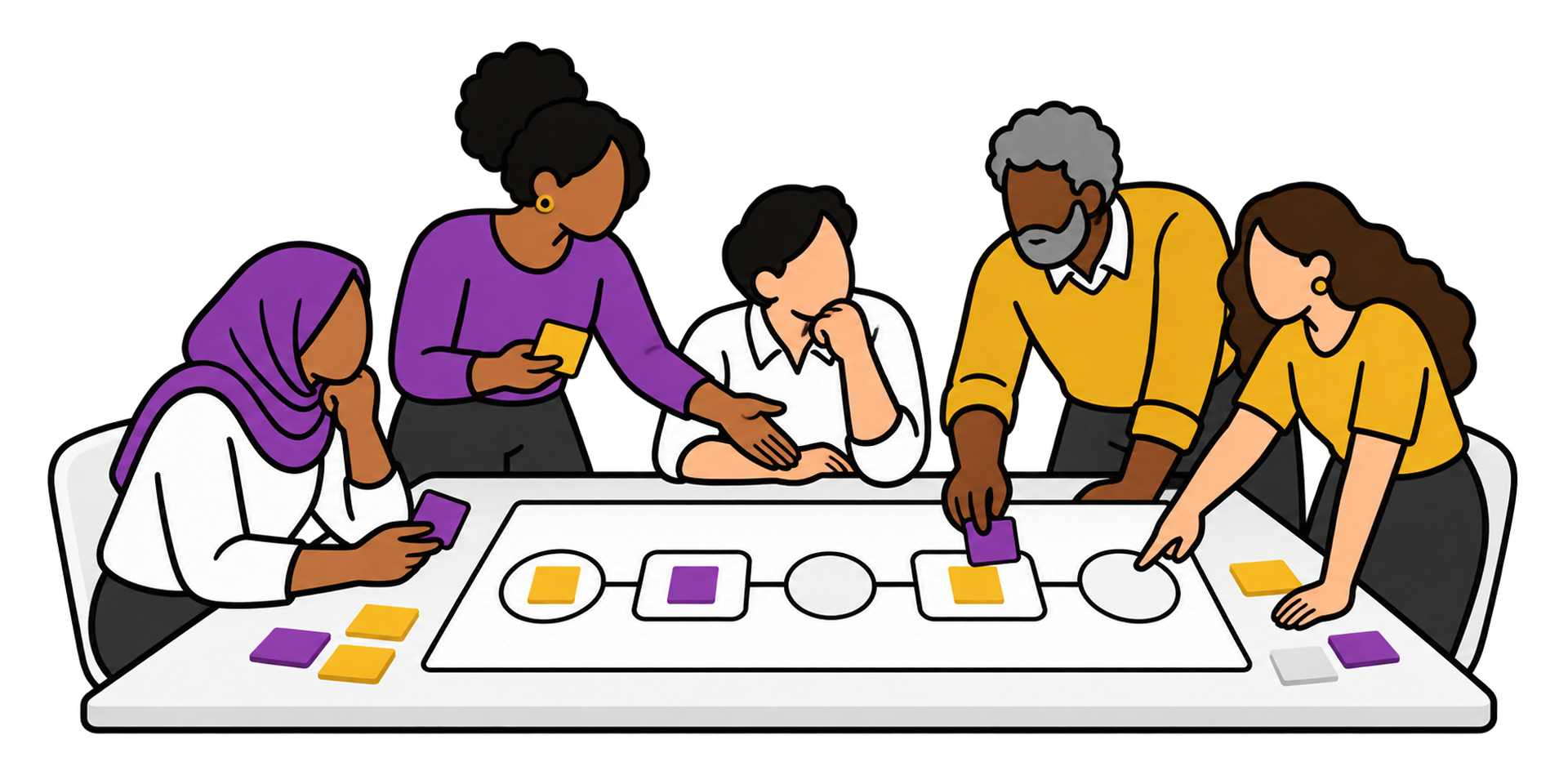
Length is really a question of depth. From my experience, here's roughly what each length allows:
- Two hours: very introductory, high-level concepts. You get the idea of focusing on Strengths, and a high-level understanding of your team.
- Half a day (about four hours): you can start to explore how your Talents can also contribute to your Weaknesses. It goes a little further, and gets more practical for your team.
- A full day: more time to dig in. You can get into how a person's results influence their needs and values, which affect their priorities and decision-making. You can learn explicit concepts to apply in different scenarios, so CliftonStrengths isn't abstract: specific plays for what to do, depending on the situation.
- Two days: the most room to go deep, and time to practice on your real work. With the coach or facilitator in the room to help bring Strengths-based approaches into the discussion, your team can work through its own topics (like planning), and practice using the language of CliftonStrengths as it goes.
The longer formats also make room for something that makes the work far more useful: embedding CliftonStrengths in your organization's work, not treating it as a parallel, disconnected topic. For example, dealing with a challenge? How can your team's results help with it? Who could you pull in who normally isn't involved? Planning next quarter? How could Strengths-based Thinking shape that plan?
In person or online?
Whenever this work can be done in person, I recommend it. There's nothing like sharing space with someone. A person's presence contributes more than what they say, and in-person interaction helps build rapport and trust.
But in person isn't always practical. If you can get the whole team together, do it. If some members are remote and can't join in person, run the whole workshop remotely. That way, everyone is on the same level, and no one feels different, isolated, or excluded.
One-to-one work, like follow-up coaching, is the easiest to do remotely. In person is still preferable, but it isn't required. So if you have to choose, prioritize doing the team work in person, and do the individual work remotely.
The more time you have, the further your team can go: from learning the concepts to using them on its real work.
What should happen before the workshop?
Once you know who's taking part and how long the workshop will be, the next step is preparing your people. And that starts with communication from the organization's leaders. People should hear why the organization is choosing to do this work, what it's striving towards, and what's expected - from the process and from each person. In particular, make sure they hear about:
- Your Vision: not only what you want to accomplish, but who you want your organization to be.
- The challenges, honestly: the ones you hope this work will address. That honesty builds credibility, because it shows you're not only talking about Vision and possibilities. You're being honest about who the organization is, where it can improve, and that you're investing in this work to make a change.
- The follow-up plan: so people know this isn't a temporary initiative. It's a long-term commitment.
- What CliftonStrengths is for: recognizing people's natural Talents and their Individuality, including Talents they likely haven't tapped yet, which the organization wants to recognize and invest in. It's not being used to judge anyone, to rank people, or to decide on roles. That's not what CliftonStrengths is for. Gallup itself calls it a development tool, not a selection tool.
- What will be shared: if people are uneasy about sharing their results, tell them that only each person's Top 5 (or Top 10) will be shared - never their bottom results. This isn't about judging or ranking people, and it isn't about limitations. It's about celebrating Individuality, building understanding, and possibly discovering someone who can help you see things in a new light.
If you need approval from your own leadership first, start with them, and share the same things: your Vision, and the challenges you hope this work will address.
Skeptics are inevitable. Don't try to force them. Be clear that this is how the organization is choosing to work going forward, and share why. Then ask them to give it an honest try, and let the experience speak for itself. (Even some of the most reluctant senior leaders I've worked with got pulled in, as you'll see below.)
When should people take the assessment?
Everyone will need to take their own assessment, online, using an access code. Plan to distribute assessment codes and instructions at least two to four weeks before the workshop. That gives people time to take it, gives someone time to follow up with anyone who hasn't, and gives your coach or facilitator time to analyze the team's results.
One thing I do that not everyone does is send each person a short survey before the workshop. It collects their thoughts, questions and concerns, so I learn more about them and have better context when I plan and facilitate the workshop. All answers are confidential, so leadership doesn't see them.
Making room for the work
Some organizations also build in prep time before the workshop. The first organization I worked with on a more comprehensive rollout wanted to use its limited workshop time for team dynamics. So we moved the introductory concepts into an individual course that each person took beforehand.
That meant asking people to fit more into their schedules. In my corporate career, I'd seen what usually happens with new development initiatives: they get piled on top of everything else, and nothing is removed to make room for them. These leaders did something different. They cleared other tasks, so each person had time to do the course. It was worked in, not piled on.
That choice sent a clear message to their people: your time is valued, what you're doing matters, and we're invested in developing you. If you're adding pre-work for your team, make room for it in their schedules too.
Tell people why you're doing this work, be honest about what you hope will change, and make room for it in their schedules.
What should happen during and after the workshop?
What happens in the room, and in the weeks after, decides whether a workshop becomes part of how your team works or fades. Leaders play a part in both.
During the workshop
A good workshop uses a variety of activities - from individual reflection, to small groups, to the whole team. The pairing I described earlier was one of these exercises. Many of them ask people to share something about how they think and work.
That only works when people feel safe to be open and share. The more welcoming and comfortable the space, the better for the team going forward. I've been in rooms where people were afraid to speak in front of their leaders. When that happens, the work can't take hold, because it depends on people feeling safe enough to be honest.
That's why leaders matter so much in the room. And as I mentioned earlier, they should take part like anyone else, modeling the same vulnerability they're hoping for from everyone else.
After the workshop: leaders go first
This is where the repetition starts. And it helps to remember that any new habit takes time to build. Research on habits in general (not CliftonStrengths specifically) shows why. In a study from University College London, a new daily behavior took 66 days on average to feel automatic. The study's lead researcher, Dr. Pippa Lally, has stressed that the range was wide: from 18 to 254 days. Missing a single day didn't significantly affect it. Being very inconsistent did.
If a leader can do only one thing after the workshop, it's this: lead your people by modeling what you want from them. That doesn't mean expecting others to act like you. It means you're the first to use what you learned. Know how your Talent Themes influence your decisions, actions and priorities, and get curious about how your people's Themes influence theirs.
Not everyone who took part will want to carry it forward. But when managers and some of their peers model the change, it ripples through the culture.
And be realistic about what it can do. Strengths-based Thinking and Talent Themes won't solve all of your problems. But they are tools that can help you solve them, when you know how and when to use them.
After the workshop: what managers can do
You don't need to do everything at once. What matters is coming back to it, again and again. A few practical ways managers can do that:
- Keep results visible. Put the team's results somewhere visible and internal (not public-facing), like a Team Grid (a simple chart showing everyone's top Talent Themes side by side). It reminds people of the workshop, and that everyone's results are different.
- Hold one-to-one follow-ups. More importantly, have each direct manager meet one-to-one with each team member. It's a chance to check in, see how they're doing, and ask if they have any questions about the work. It's also a chance to start bringing Strengths-based topics and language into everyday conversations. The spirit is exploration, not testing.
- Do callbacks in team meetings. Reinforce a point from the workshop, or mention a win from that week that came from leaning into Strengths-based work.
- Invest in each person's top Talent Themes, through more learning or a new, different project (with their buy-in).
In those everyday conversations, a few questions can help managers get started:
- On a project: "What Talents do you think you're leading with on this project?"
- When someone's stuck: "How might you approach this differently if you pulled in other Talent Themes?" Or: "Is there someone on the team with different Talent Themes who might help you see this a different way?"
The questions for when someone's stuck matter most. We tend to use certain Talent Themes in certain situations, and other Themes in others. So when someone's stuck, trying a different mix of their top Talent Themes can lead to a different approach, and possibly a different outcome.
My article on what makes a rollout stick has a few more ideas, including how to weave CliftonStrengths into goals and reviews: Reinforcement: How does this show up in everyday work?
After the workshop: what each person can do
For each person on the team, the most important habit is to keep exploring their Talent Themes: what they mean, and how they show up in their life. That goes for you, too. Strengths-based Thinking goes against the grain. Most people focus on problems, and on fixing them. And Talent Themes can seem abstract at first. A few ways to start:
- Immerse yourself in the topic. Read about your Talent Themes, and listen to videos or podcasts about them.
- Observe your own life. Once you understand your Themes better, notice how they show up, how you use them, when they help you, and when you might be using them in a way that hurts you. That's eye-opening. Sometimes your Talents actually contribute to your Weaknesses.
- Keep observing honestly. That's the point. Notice what you're discovering.
Eventually, with practice, using your Talent Themes becomes an intentional choice, not an autopilot reaction.
Be the first to use what you learned, and keep coming back to it. That's what turns a workshop into how your team works.
FREE GUIDE
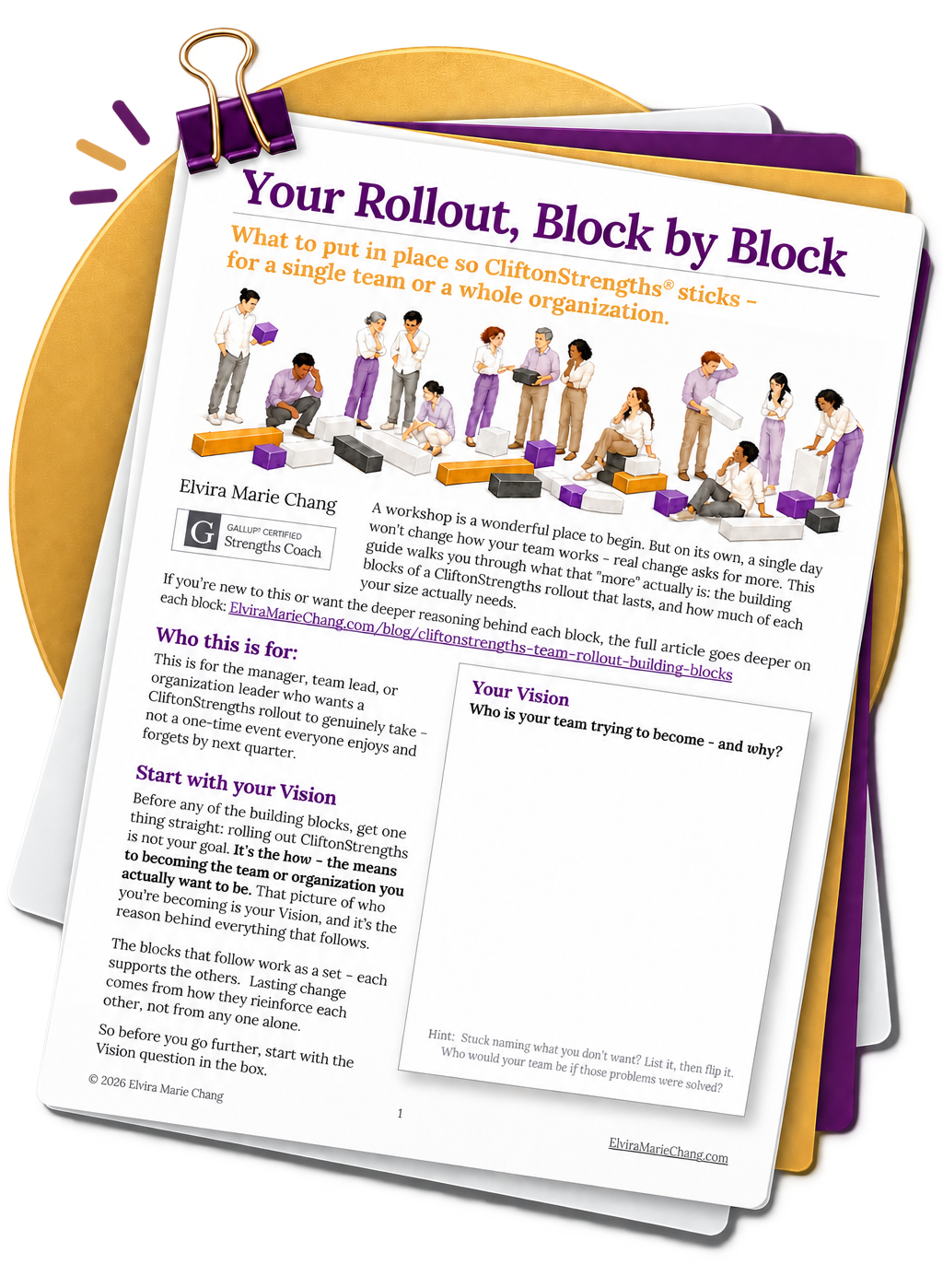
Your Rollout, Block by Block
This article answers the questions leaders ask before and after a workshop. If you'd like to plan what comes after it in more detail, I put together a free guide. It walks through eight building blocks that help the work last, with an at-a-glance view of how much of each a single team needs versus a larger organization.
When will we see a difference, and how will we know it's working?
Often, a team notices a difference during the workshop itself. You can see it in how eager people are to share what they discover. That first shift is real. Whether it lasts depends on what comes next.
I've even had senior leaders tell me they weren't convinced about this work, and agreed to it only because the leaders who report to them wanted it. And even they got pulled in. They took part, and experienced the shift in energy in their group firsthand. It's contagious.
So the energy and the benefit are palpable. The longevity is in the follow-up and the follow-through.
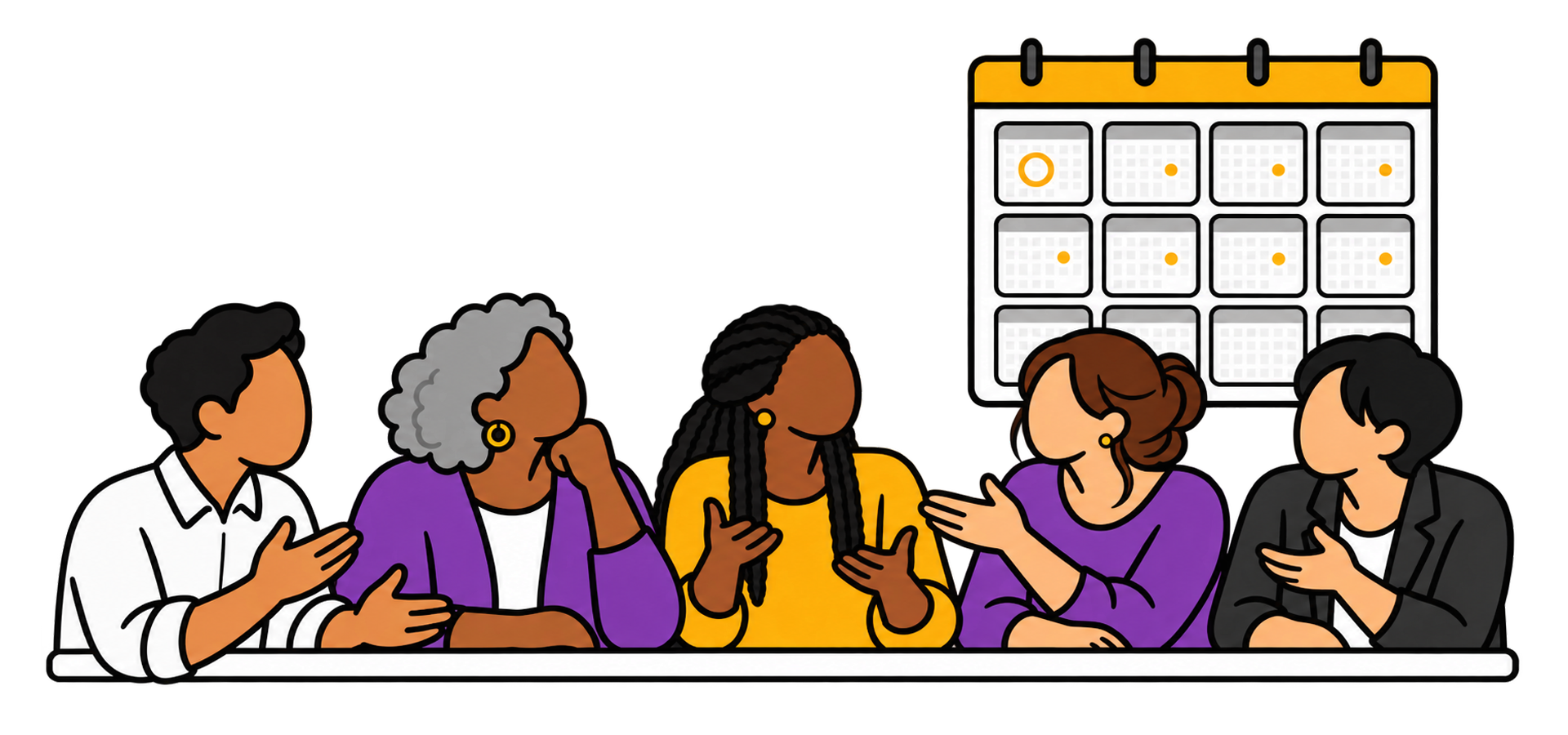
For lasting change, give it a few months of steady follow-through, not weeks. That's in line with the habit research above, and enough time to build a solid foundation. But the follow-through needs to keep going after that. Otherwise, the work eventually gets dropped when tasks and deadlines pile up.
How will we know it's working?
Start by looking at yourself. Are you still modeling what you want from your team?
Then listen to the language around you. Is the focus on constraints, or on Strengths and what's possible? Constraints aren't ignored. They're just not the focus.
And watch for signs like these:
- People leaning into different Strengths and Talents.
- People being intentional, rather than reacting on autopilot.
- Different teams working together more constructively.
None of these show up overnight. But when you start seeing and hearing more of them, you'll know the work is taking hold.
The first shift often happens in the room. Whether it lasts is in the follow-through.
Bringing it back to your Vision
Remember the questions at the start of this article: what do you want this work to add to your team, and who do you want your team to become? That's your Vision, and it's where everything else in this article starts.
From there, the practical questions fall into place. Every team's plan will look different, and each step has more to it than a list can show. But at a high level, here's how the planning tends to go:
- Name your Vision: what you want this work to add to your team.
- Find a Gallup-Certified Strengths Coach, and check their availability, ideally two to three months ahead.
- Build the plan together with your coach: who will take part, how long the workshop will be, whether it will be in person or online, and what comes after it. A good coach helps shape the plan around your Vision, not just deliver the workshop.
- Share the why with your people: your Vision, the honest challenges, and the follow-up plan.
- Distribute assessment codes two to four weeks before the workshop.
- Hold the workshop, with leaders taking part.
- Follow through: leaders go first, managers hold one-to-ones, and everyone keeps exploring.
A workshop may be where your team starts. It doesn't have to be where it stops. Whatever you can do right now, plan it with the bigger picture in mind.
If you'd like to see how I work with teams, you'll find it here: CliftonStrengths Workshops for Teams.
Don't just plan a workshop. Plan for who your team will become.
Frequently asked questions
Should our team take the CliftonStrengths Top 5, Top 10, or all 34?
Each person needs their own assessment, so the cost adds up quickly, especially for a larger team. That's a real part of your budget. But it's also part of the investment in your people, and the more of their results they can see, the more they have to work with. In order of preference:
- The full 34, for everyone, if you can. Talent Themes 6 to 10 really add dimension to each person's Top 5, and they add more tools to each person's toolbag.
- If not, a Top 10 report. Gallup's Top 10 results come through its role-based reports, such as CliftonStrengths for Leaders, CliftonStrengths for Managers and CliftonStrengths for Sales. They cost a little less than the full 34.
- The Top 5, after that.
For leaders, I'd definitely recommend the full 34 - not to judge, but so they can see where their blind spots might be (for their own insight, not for sharing).
What if some people already have their results?
It depends on how long ago they took the assessment, and whether your organization can access their results. Gallup says most people don't need to retake it. It may make sense if someone took it more than 10 years ago, rushed through it, or has had a major life change.
That said, there's value in having everyone take it at the same time. It gives your team a clean starting date. It also keeps everyone's results together in Gallup Access (Gallup's online platform) and its tools, like the Team Grid. Older results may not be grouped with the rest of your team's there, so for some people, taking it again is simply easier. If you work with a coach, ask how they'll access your team's results. (For example, I only have access to results for assessments I've administered.)
What drives the cost of a CliftonStrengths workshop?
A few things: the number of people, the services you choose (a workshop only, follow-up sessions, coaching), the cost of the assessments, the length, whether it's in person or online, and any travel expenses for your coach or facilitator. Focus on what you want the work to do for your team, and build a program from there.
How far ahead should we plan?
At least a month ahead, and ideally two to three months or longer. Part of that planning is finding the right Gallup-Certified Strengths Coach to work with you, and checking their availability early, since coaches' calendars can fill up by date.
- One month is the absolute minimum, but that's tight. Your organization needs to be clear on what it wants right away, because the assessment codes need to go out within a week or two to get everyone's results back in time.
- Two to three months (or longer) is better. That gives you time to work with your coach on a clear plan of what you want and when, and time to work out variables you'd never considered before. No rushing.
What about people who join the team after the workshop?
At a minimum, have them take the assessment, so their results can be rolled in with the rest of the team's. You might also pair them with someone in the organization who can mentor them through Strengths-based topics. One option I've offered in the past is an individual course that new hires and transfers can take on their own, so they're caught up on the concepts. It's not the same as taking part in a team-wide workshop, but at least they'll be familiar with what everyone is talking about.
How do I find and choose a CliftonStrengths coach?
You can find Gallup-Certified Strengths Coaches through Gallup's directory of certified coaches, which you can search by country, state or province, and language. This is likely the person who will facilitate your workshop, so screen for fit.
Every coach is going to be different, because of their own Talent Themes. Look for someone who'd be a good match for your organization and its goals, and who can provide the services you're after. A few things to ask yourself as you talk with them:
- Are they taking the time to get to know your organization and your needs, or just presenting pre-packaged options?
- Are they pointing out factors you hadn't considered that would improve the work for your organization?
- Do they share your blind spots? It's often easier to work with someone who seems aligned with you. Just make sure they can see what you might miss.
- Depending on what you're planning, how will you work together to handle any hiccups that come up along the way?